BMW Wastegate Duty Cycle (WGDC), Explained
Wastegate duty cycle is the number in a BMW datalog that shows how hard the DME is working the boost-control actuator. It is a command, not a measurement — and how you read it depends entirely on whether the car runs a pneumatic wastegate (PWG) or an electronic wastegate (EWG), which ECU family it uses, and which channel your logging software is actually showing you. This guide covers what WGDC represents, what high and low values can and cannot tell you, how it behaves through spool, steady boost and redline, the difference between PWG and EWG control, platform notes for the N54, N55, S55, B58 and S58, and a diagnostic workflow that reads WGDC the way a tuner does — always alongside boost error and the supporting channels.
Reviewed by Justin, Owner & BMW Calibration Specialist at Synergy BMW Tuning · Updated September 2026.
The one rule. WGDC is never judged alone. It is the DME's answer to a question — "how far is boost from target right now?" — so it only means something read against boost error, the operating region of the pull (spool, steady, redline), and the channels around it. There is no universal "correct" percentage, and the sign convention itself differs by platform and logger.
What WGDC is (direct answer)
What is wastegate duty cycle?
Wastegate duty cycle (WGDC) is the DME's command to the boost-control actuator, expressed as a percentage. On a pneumatic wastegate it is an effort command to a solenoid that meters vacuum or control pressure to the actuator. On an electronic wastegate it is close to a commanded actuator position. In both cases it is a control output the ECU calculates — not a sensor reading of where the wastegate flap physically sits.
A turbocharger makes more boost when more exhaust energy is forced through the turbine and less when the wastegate opens a bypass path around it. The DME cannot move exhaust directly, so it moves the wastegate, and WGDC is the signal it sends to do that. Everything else in this guide is about the gap between that command and the result.
What wastegate duty actually represents
WGDC represents control effort: how hard the DME is driving the actuator to hold the wastegate against exhaust pressure. It is derived from the DME's boost model — a feed-forward estimate of what the turbo needs to do to hit the requested load — and then trimmed by a closed loop that watches boost error. When boost is under target the loop raises effort; when boost is at or over target it backs off.
What the raw number looks like depends on the hardware. On a pneumatic system, duty is the percentage of time a solenoid is energised, which sets the average control pressure reaching the actuator diaphragm. That translates to a flap position only in combination with spring preload, actuator condition and the exhaust pressure trying to push the flap open — so two cars showing the same duty can have the wastegate in different places. On an electronic system, the commanded value is much closer to an actual position because a servo drives the flap directly and a sensor reports back where it went.
Because of this, the single most important habit is to confirm what your logging software's channel is: a feed-forward base value, a post-correction value, a final output, a commanded position, or an actual position. Tools name and scale these differently, and some invert the sign relative to what you would expect.
Why tuners watch WGDC
Boost target and actual tell you whether the car is hitting its number. WGDC tells you how much it is costing to get there. Two logs can both show boost on target, but the one holding it at low, stable effort has headroom and the one holding it with effort pinned near its limit does not — the next hot day, small leak, or worn coupler will push it under target.
- Headroom. How much control authority is left before the wastegate is fully commanded and boost can only fall.
- Stability. Smooth effort means a stable boost loop; rapid oscillation means a solenoid, actuator or tuning problem.
- Direction of a fault. Effort moving the wrong way for the boost error — rising while boost climbs past target, or low while boost falls short — narrows the cause quickly.
- Repeatability. The same effort producing the same boost pull after pull is the signature of a healthy setup.
WGDC vs boost target and actual boost
WGDC is the DME's response to boost error, so it is always read as a triplet: target, actual, and the effort being spent to close the gap. Healthy behavior is actual tracking target once the turbo is spooled, with effort settling to a stable working level — not pinned, not hunting.
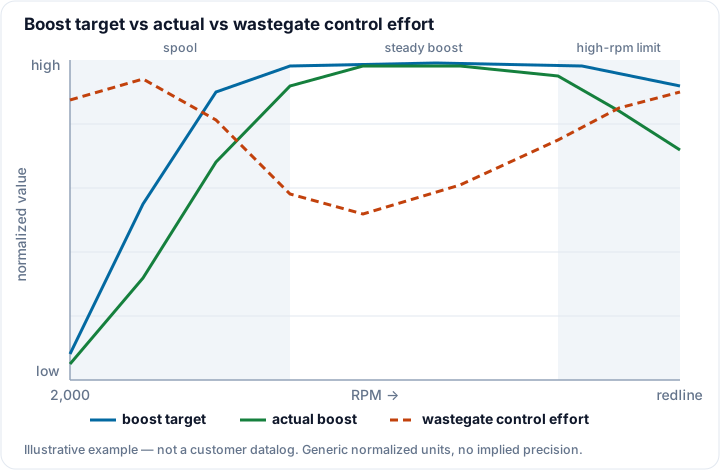
Read the three traces as a sequence. Effort is high while the turbo builds. As actual boost approaches target, effort drops sharply — the loop only needs to hold, not to push. Through the mid-range, small effort movements keep actual pinned to target. Toward redline, effort creeps back up: exhaust flow and backpressure are higher, the turbo is less efficient, and holding the same boost costs more. If actual still tracks target while that happens, nothing is wrong. If actual falls away as effort rises, you have found a limit — the rest of this guide is about identifying which one.
One caution: boost target is not fixed during a pull. The DME trims it for intake air temperature, barometric pressure, gear and coolant temperature, so a target that steps down as IAT climbs is the model working as designed. Judge effort against the target that was actually commanded at that instant, not against a headline number.
WGDC during spool
During spool the wastegate is commanded shut and effort is at or near its maximum, because every bit of exhaust energy should go through the turbine to accelerate it. High duty here is expected, not a fault. All else equal, more effort during spool spins the turbo faster and boost arrives sooner.
Normal: Effort high and steady while boost rises smoothly toward target, then dropping back as actual boost approaches target with at most a small, settling overshoot.
Investigate if: Effort oscillating rapidly while boost surges and sags, boost taking much longer to build than a previous log, or a large sustained overshoot that does not settle.
Community-observed rules of thumb, not fixed limits — your calibration, wastegate architecture and platform set the real thresholds.
Spool behavior is read differently by platform. A single-turbo car and a stock-frame twin-turbo have different spool shapes, and a larger aftermarket turbo will hold effort high for longer before boost catches up. Compare a spool trace only against another spool trace from a similar setup — never against the steady-state part of the same pull.
WGDC at steady boost
Once boost is on target, effort should settle to a stable working level and make only small corrections around it. That working level is specific to the map, the turbo and the platform — there is no "normal" percentage to compare against, only your own previous logs.
- Stable mid-range effort, boost on target — the loop is comfortable and has authority in hand.
- Effort already high in the mid-range, boost on target — the car is hitting its number but with little headroom left for redline or a hot day.
- Effort hunting up and down while boost wobbles — an unstable loop: solenoid, actuator, preload, or a calibration that is too aggressive for the hardware.
The most useful comparison here is log-over-log. If the steady-state effort needed to hold the same target has crept up between two otherwise-identical pulls, something has changed — a developing leak, a tiring wastegate, or a turbo losing efficiency.
WGDC near redline
It is normal for effort to rise toward redline even with boost still on target. Exhaust mass flow and backpressure are highest there, the turbo is furthest from its efficient range, and the wastegate wants to be pushed open — so the DME commands more effort to keep it shut. On a stock-frame turbo a gentle boost taper up top is also expected as the compressor runs out of efficiency.
Normal: Effort climbing gradually toward redline while actual boost holds target or tapers only slightly, matching previous logs.
Investigate if: Effort reaching its maximum well before redline while boost falls increasingly short, or effort climbing far faster than in an earlier baseline log of the same car.
Community-observed rules of thumb, not fixed limits — your calibration, wastegate architecture and platform set the real thresholds.
The distinction that matters at redline is effort rising with boost held (the system is working harder but succeeding) versus effort rising with boost falling (the system is working harder and losing) — covered next.
High WGDC: what it can mean
Is high WGDC bad?
Not by itself. High control effort is normal during spool and can be normal near redline. It only becomes a concern when it is paired with boost under target, or when it is much higher than the same car needed in a previous log to hold the same boost.
High effort, read against boost error, points in different directions:
- High effort, boost on target — the system is doing its job. Note how much headroom is left, but there is no fault.
- High or pinned effort, boost under target, positive part-throttle fuel trims — a charge-air leak: the wastegate is working hard and still missing target while unmetered air shows in the trims.
- Pinned effort, boost under target, trims and everything else normal — the turbo is at its flow limit, or an exhaust restriction is limiting it, or a worn wastegate will not seal.
- Effort higher than your own baseline for the same target — something has changed: a developing leak, a tiring actuator, or a turbo losing efficiency over time.
Low WGDC: what it can mean
Is low WGDC good?
Not automatically. Low effort with boost on target is healthy and means the wastegate has authority to spare. Low or falling effort with boost above target is the signature of boost creep. Low effort while boost is still climbing hard during acceleration is unusual and worth checking against the commanded target.
- Low effort, boost on target — the best case. The loop barely has to work to hold the number.
- Low or falling effort, boost above target — creep: the wastegate is commanded open and boost is still climbing because it cannot bypass enough exhaust.
- Effort lower than your baseline for the same boost — usually benign (cooler, denser air, better fuel), but confirm against IAT and baro rather than assuming.
On a pneumatic system, remember that "low duty" still leaves spring preload holding a base boost level. The wastegate is not wide open at 0% effort; it is at whatever position the spring and exhaust pressure settle on.
Rising WGDC with falling boost
Effort climbing while boost falls away — usually at high RPM — means the boost-control system has run out of authority. The DME is asking for everything and getting less. This is one of the clearest single signatures on a log, but it still has several possible causes and WGDC alone does not separate them.
- Turbo at its flow or efficiency limit — common on a stock-frame turbo near redline or on a car asking for more than the turbo can support. Nothing is broken; it is a hardware ceiling.
- Charge-air leak — a coupler or pipe that holds at low boost but lets go under peak pressure. Look for positive part-throttle fuel trims and a hissing test.
- Exhaust restriction — a clogged catalytic converter, a collapsed flex-section, or an over-restrictive downpipe raises backpressure and steals turbine energy.
- Wastegate that will not seal — a worn flap, weak actuator or lost preload lets exhaust slip past even at maximum commanded effort.
- Trimmed-down target — always check first. If IAT is high or baro is low, the target itself dropped and the "fall" is the model, not a fault.
Overboost with low or falling control effort
Boost above target while effort is low or falling means the wastegate cannot hold boost down — the classic boost-creep pattern. The DME is commanding the gate open and boost keeps climbing anyway because the wastegate port or the exhaust manifold cannot bypass enough flow.
- Wastegate or manifold flow limit — the most common cause on cars with upgraded turbos and restrictive stock or cast manifolds. Boost climbs at high RPM with the gate fully commanded open.
- Preload too high — on a pneumatic actuator, excess preload holds a base boost the wastegate cannot fall below even with no control pressure.
- Actuator or linkage binding — a rod, bushing or arm that sticks part way, so the flap never reaches the commanded open position.
- Short spike that settles — a brief overshoot on tip-in that the loop pulls back is normal wastegate-loop behavior, not creep.
Sustained overboost is a knock and reliability risk, and the DME may cut torque or throw a code if actual exceeds target by enough. If you see it, lift — do not keep logging into it.
Boost leaks and WGDC
Can WGDC diagnose a boost leak?
It contributes but does not prove it alone. A charge-air leak shows as higher-than-normal effort for a given boost target, effort pinned while boost still falls short, and often positive part-throttle fuel trims from air entering after the sensor. WGDC plus boost error plus fuel trims together point to a leak; the duty channel by itself does not.
A leak between the compressor outlet and the intake valves means some of the air the turbo moves never reaches the cylinders. To hit the same manifold pressure the turbo has to work harder, so the DME commands more effort to keep the wastegate shut. A small leak shows as elevated effort with boost still on target; a larger one shows as effort pinned with boost under target and the gap widening as pressure — and therefore leak rate — rises with RPM.
Confirm with a pressure test of the charge-air system, not from the log. After the fix, boost should meet target at noticeably lower effort and any unmetered-air fuel trims should settle. The datalog guide covers the fuel-trim side of this in detail.
Wastegate, actuator and preload issues
Mechanical problems at the wastegate change the relationship between the commanded effort and the resulting boost, so the log looks like a control problem when the cause is hardware.
| Problem | Applies to | Log signature |
|---|---|---|
| Worn flap / seat | PWG and EWG | Cannot hold low boost; rattle at idle and light load; creep or under-target boost up top; unstable effort. |
| Preload too low | PWG | Boost sags below target in the mid-range; effort high early trying to compensate. |
| Preload too high | PWG | Base boost the car cannot fall below; overboost or creep with effort commanded low. |
| Weak / lazy actuator or solenoid | PWG | Slow, oscillating boost response; effort swinging while boost surges and sags. |
| Actuator wear / binding | EWG | Actual position lagging or failing to reach commanded position; boost-control drift; stored wastegate adaptation or position faults. |
| Adaptation not learned | EWG | Inconsistent boost after a battery disconnect or actuator replacement until the wastegate end-stops are relearned. |
Preload and actuator specifics are platform- and part-dependent. Set preload to the tuner's or manufacturer's guidance for your setup — do not copy a figure from another platform.
Turbo efficiency and exhaust-side limits
The wastegate can only regulate boost by diverting exhaust. Anything that changes how much turbine energy is available, or how freely exhaust leaves the engine, changes the effort the DME needs for a given target.
- Compressor efficiency. As airflow demand moves a turbo out of its efficient range — typically toward redline — it needs more turbine energy for the same pressure ratio, so effort rises. A turbo sized well for the target holds boost at lower effort across the band.
- Exhaust backpressure — and which side it is on. Restriction upstream of the turbine (small stock manifold runners, a small internal wastegate port) raises turbine-inlet pressure and can aggravate creep. Restriction downstream of the turbine (an aging catalytic converter, an over-restrictive downpipe) lowers the turbine's expansion ratio, reduces turbine power and usually costs top-end boost — effort rises to compensate. Removing a downstream restriction can also unmask creep on a car whose wastegate was already marginal.
- Wastegate port sizing. An internal wastegate with a small port cannot bypass enough flow for a large turbo, which is the mechanical root of most creep.
- Turbo condition. Shaft play, damaged blades or a failing seal all reduce efficiency and raise the effort needed, often getting worse over weeks.
None of these can be confirmed from WGDC alone. They are inferred by ruling out leaks and control faults, checking a backpressure gauge or an exhaust inspection, and comparing the car against its own earlier baseline. The big turbo checklist and the downpipe guide go into the exhaust-side hardware.
Environmental conditions
Ambient conditions change both the boost target the DME asks for and the effort needed to reach it, so the same car logs different WGDC on different days.
- Intake air temperature. Hotter charge air is less dense and knocks more easily, so the DME trims the boost target down and can pull timing. Effort may look lower simply because the target is lower.
- Barometric pressure and altitude. At altitude the target drops with ambient pressure, and the turbo has to work harder for the same absolute manifold pressure, so effort can rise even as the gauge number falls.
- Air density generally. Cold, dry, low-altitude air is the easy case; hot, humid or high-altitude air makes the loop work harder for less.
This is why a "my WGDC went up" comparison is only valid between logs taken in similar conditions. Log IAT and barometric pressure alongside WGDC so you can tell an environmental shift from a developing fault.
Pneumatic wastegate control (PWG)
A pneumatic wastegate is moved by a spring-and-diaphragm actuator. The DME does not drive the flap directly — it drives a solenoid that meters vacuum or control pressure to the actuator, and the pressure balance plus the spring decide where the flap sits.
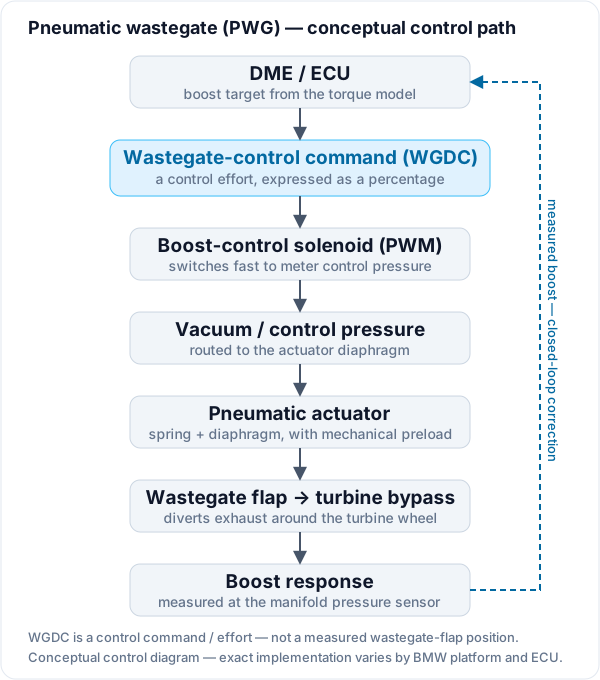
- The solenoid switches on and off many times a second. The duty cycle — the fraction of time it is energised — sets the average control pressure at the actuator.
- On the N54, the arrangement is vacuum-based: applying vacuum pulls the wastegate closed, and with no vacuum the flap rests open. Higher commanded duty means more effort to hold the gate shut, which means more boost. Community logging guides note that duty in the 80%+ range is normal while the turbos are building boost.
- Spring preload sets the base boost the wastegate holds with no control pressure applied. Two identical cars with different preload will need different duty to hit the same target.
- Actuator and flap condition matter directly. A tired diaphragm, a worn flap or a stretched spring all shift the duty-to-boost relationship.
The key interpretation point: on a PWG car, WGDC is not a flap position. It is an effort command, and the physical result depends on mechanical parts the log cannot see. Treat the number as "how hard the DME is trying," and read the boost channels for what it achieved. For a full treatment of the datalog side, see the BMW datalog guide.
Electronic wastegate control (EWG)
An electronic wastegate is moved by an electric servo motor with an integrated position sensor. The DME commands a position, the actuator drives to it, and the sensor reports back where it actually went.
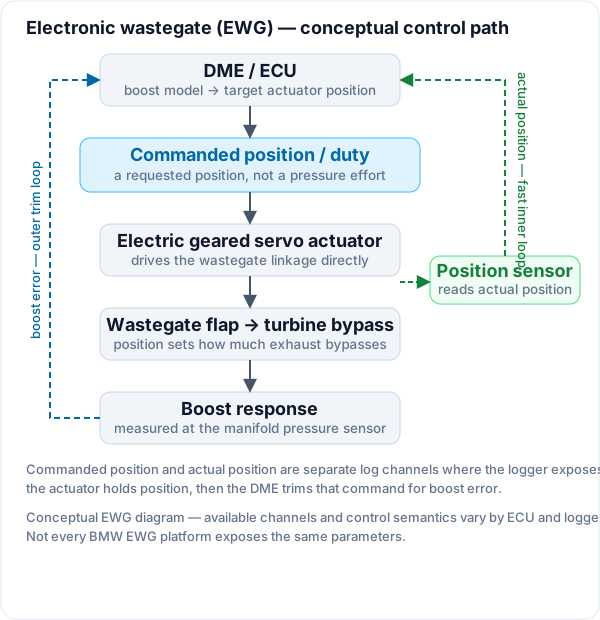
- Two loops. A fast inner loop holds the actuator at the commanded position; a slower outer loop trims that command based on boost error. Some tuning platforms build the base command from a compressor-power model — an estimate of how much exhaust energy the turbo needs for the requested boost and load — and then fine-tune on boost error.
- Commanded vs actual position. Where the logger exposes both, a persistent gap between them points to actuator wear, binding, or an unlearned adaptation — not a tuning problem.
- Sign convention. On some platforms the duty channel is scaled so that 100% means the commanded position is fully closed and 0% means fully open. On at least one major B58 tuning platform, holding a sustained 100% commanded position is treated by the ECU as an error state and the wastegate is opened after a short delay — so "pinned at 100%" is not the same healthy signal it is on a pneumatic car.
- Precision. Because the servo positions the flap directly, EWG control holds target more tightly and resists oscillation better than PWG, especially near redline.
PWG vs EWG compared
What is the difference between PWG and EWG?
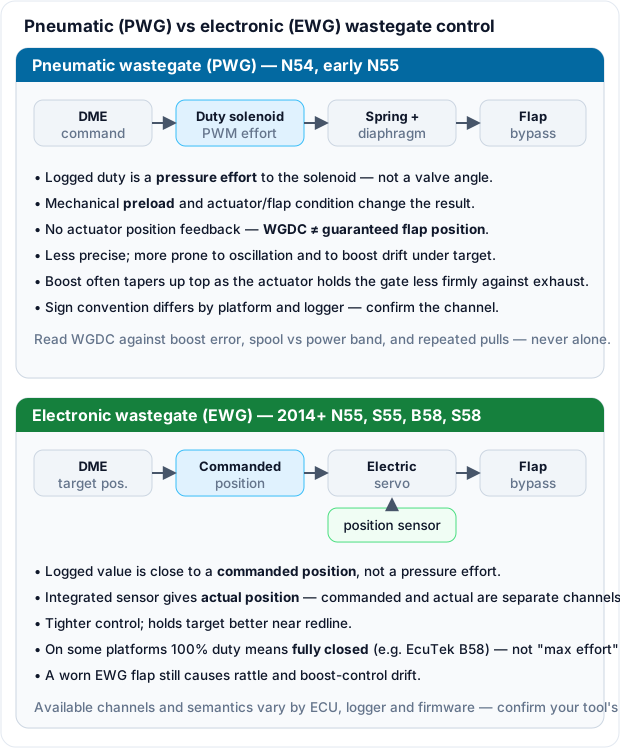
A pneumatic wastegate is pressure-actuated through a duty-cycle solenoid, so the logged duty is a control effort and the flap position also depends on spring preload and actuator condition. An electronic wastegate is servo-positioned with sensor feedback, so the logged value is close to a commanded position and actual position is usually available too. EWG control is more precise, oscillates less, and holds boost better at high RPM.
| Dimension | Pneumatic (PWG) | Electronic (EWG) |
|---|---|---|
| Actuation | Spring + diaphragm, moved by vacuum / control pressure metered by a PWM solenoid | Electric geared servo driving the wastegate linkage directly |
| What the logged value means | A control effort (solenoid duty) | Close to a commanded actuator position |
| Position feedback | None — flap position is inferred, not measured | Integrated position sensor; actual often logged separately |
| Mechanical preload | Sets base boost; part of the duty-to-boost relationship | Not a tuning variable in the same way |
| Precision & stability | Lower; more prone to oscillation and to boost drift under target | Higher; holds target tightly, better top-end retention |
| BMW platforms | N54, N55 before roughly mid-2013 | N55 from roughly 2014, S55, B58, S58 |
| How to read the channel | As effort vs boost error; remember preload and actuator wear sit between the number and the result | As commanded vs actual position; know your platform's sign convention and 100% rule |
Platform-specific interpretation
The wastegate architecture, the ECU family and the logging software together decide what the WGDC channel means, so a read that is correct on one platform can be wrong on another. This table is a starting point, not a specification — confirm the channel definition in your own tool.
| Platform | Wastegate architecture | How to read the WGDC channel | Useful companion channels |
|---|---|---|---|
| N54 | Parallel twin turbo; pneumatic wastegates, vacuum-closed | Effort command to the boost solenoid; high duty normal during spool; boost-control slop and solenoid wear are common; watch for oscillation. | Boost target/actual, part-throttle fuel trims, IAT, per-cylinder timing correction |
| N55 (PWG) | Single twin-scroll; pneumatic on early cars (through roughly 2013, with some model exceptions) | Same as N54 in principle: an effort command. Confirm the car is actually PWG (early build, extra solenoid connector) before applying PWG logic. | Boost target/actual, wastegate solenoid duty, IAT, baro |
| N55 (EWG) | Single twin-scroll; electronic wastegate on later cars (roughly 2014 on) | Close to a commanded position; holds target better up top than PWG; flapper wear causes rattle and boost-control drift. | Commanded vs actual wastegate position, boost target/actual, load |
| S55 | Twin turbo; electronic wastegates | Commanded-position style. Boost control is generally precise; fuel-system and heat limits usually show before wastegate limits on pump gas. | Wastegate position (per turbo where available), boost target/actual, HPFP, IAT |
| B58 / B58 Gen 2 | Single twin-scroll; electronic wastegate | Duty means position. On at least one major B58 platform (EcuTek) 100% is fully closed, 0% fully open, and a sustained 100% command is treated as an error state; the base command comes from a compressor-power model, then trims on boost error. Confirm your own tool's convention. Gen 2 also hits load and relative-filling limiters that can look like a boost problem. | Wastegate position command/actual, compressor power, relative filling, fill-limit flags, boost target/actual |
| S58 | Twin turbo, closed-deck; electronic wastegates | Newer MG1-generation DME with position-style wastegate control and fill-limit-reason flags. Tuning support is mature but publicly documented failure-mode logs are still relatively thin. | Wastegate position per turbo, fill-limit reason, boost target/actual, HPFP, IAT |
Channel availability depends on the ECU, the firmware and the logging software. Not every platform exposes commanded and actual position, per-turbo channels, or a feed-forward base value — log what your tool offers and confirm what each channel represents.
Companion log channels
What should be logged alongside WGDC?
At minimum: RPM, pedal and throttle-plate position, boost target and actual, and calculated load or relative filling. Add wastegate position where the logger exposes it, plus IAT, barometric pressure, timing correction and part-throttle fuel trims. WGDC only becomes diagnostic when it is read together with boost error and the operating context.
| Channel | What it adds |
|---|---|
| Boost target & actual | The boost error WGDC is responding to. Nothing about duty means anything without it. |
| Wastegate position (commanded & actual) | On EWG platforms, whether the actuator is reaching the position the DME asked for. |
| WGDC base / post-PID / final | Where a logger exposes them, separates the feed-forward command from the closed-loop correction — useful when the loop is fighting the model. |
| RPM & pedal / throttle plate | Confirms the pull was wide open and locates spool vs steady vs redline. |
| Calculated load / relative filling | Whether a flat boost or effort trace is actually a load-model limit, especially on B58 Gen 2 and S58. |
| IAT & barometric pressure | Whether the boost target itself was trimmed — separates weather from a fault. |
| Part-throttle fuel trims | Positive trims plus high effort point to unmetered air from a charge-air leak. |
| Timing correction | Whether the DME cut boost for knock — a torque intervention, not a boost-control fault. |
On MHD, wastegate duty is exposed as more than one channel — commonly a base value, a post-correction value and a final value — plus separate boost-target channels. bootmod3 and other tools present their own set. Log the same channels every time so revisions compare like for like.
Diagnostic workflow
A practical order for working a boost or WGDC question. It is a framework, not an absolute fault tree — steps overlap and you loop back as channels rule causes in or out.
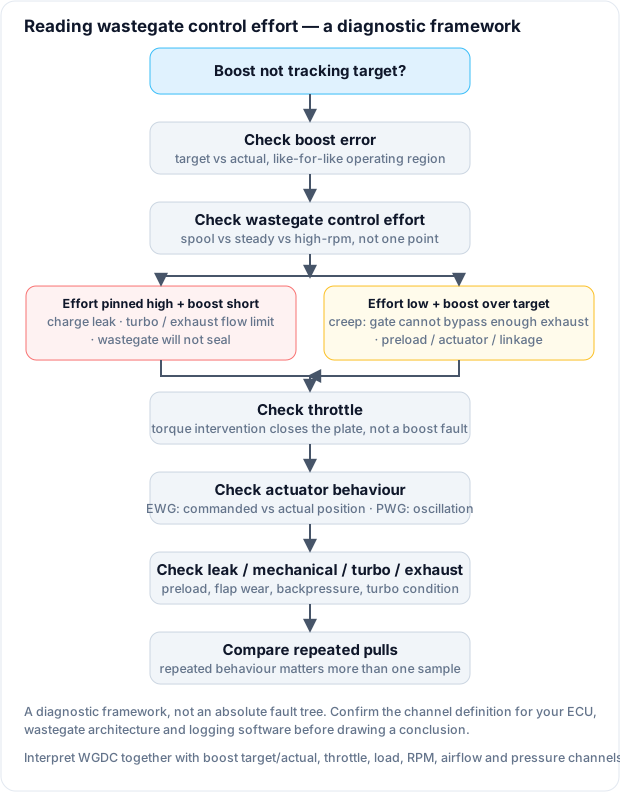
- Identify the platform — N54, N55, S55, B58, S58, and the generation.
- Identify the wastegate architecture — pneumatic or electronic. On the N55 specifically, confirm which one this car has.
- Confirm the channel definition — is your WGDC channel a base command, a final output, a commanded position or an actual position, and which way does the sign run?
- Isolate the valid region — one continuous wide-open pull in one gear. Ignore shifts, lifts, traction events and tip-in.
- Look at RPM — locate spool, steady boost and the approach to redline.
- Compare boost target vs actual — establish the boost error at each point.
- Read WGDC against that error — is effort moving the right way for the gap?
- Check throttle — a plate closing with the pedal flat is torque intervention, not a boost fault.
- Check actuator behavior — on EWG, commanded vs actual position; on PWG, how smooth the effort is.
- Separate spool from steady from redline — never judge one region by another region's behavior.
- Check supporting channels — IAT, baro, fuel trims, timing correction, load and fill-limit flags.
- Consider mechanical, airflow and exhaust-side limits — preload, flap wear, backpressure, turbo condition.
- Compare repeated pulls — repeated behavior is a finding; one sample is not.
- Do not diagnose from WGDC alone.
Common interpretation mistakes
- Treating a percentage as universal. "My WGDC is 90%, is that bad?" has no answer without the platform, the channel, the boost error and the operating region.
- Reading PWG and EWG logs the same way. Effort pinned at 100% is normal on a spooling N54 and an error state on some B58 calibrations.
- Judging spool effort against steady-state effort. They are different jobs; high duty during spool is expected.
- Ignoring the target trim. Boost "falling" at high IAT or altitude is often the commanded target dropping, not a control failure.
- Assuming duty equals flap position on a pneumatic car. Preload and actuator wear sit between the command and the result.
- Reading the shift or lift window. Torque-reduction events during an upshift pull boost and move duty; ignore them.
- Diagnosing from one pull. Confirm the behavior repeats before acting on it.
- Changing two things between logs. New map and new coupler at once means the next log cannot isolate anything.
Example scenarios
Each of these is an educational pattern, not a specific car and not a customer log. The point is the sequence: a signature raises a question, the other channels answer it.
Scenario A — boost below target, control effort rising
Signature: through the mid-range actual boost sits under target and the gap widens with RPM; wastegate effort climbs toward its limit. Read: the loop is asking for more and not getting it. Next: check part-throttle fuel trims (positive points to a charge-air leak), IAT and baro (a trimmed target), and timing correction (a torque cut). If those are clean and effort is pinned, suspect a turbo or exhaust-side flow limit and confirm with a pressure test and a backpressure check.
Scenario B — boost on target, control effort stable
Signature: actual tracks target from spool to redline; effort settles to a steady working level with small corrections and rises only gently up top. Read: a healthy boost loop with authority in hand. Next: nothing — record the effort level as your baseline so a future log can be compared against it.
Scenario C — boost above target, control effort falling
Signature: actual climbs past target at high RPM while the wastegate is commanded further open and effort drops. Read: boost creep — the wastegate or manifold cannot bypass enough exhaust. Next: check preload (too high on a PWG car), inspect the wastegate port and flap, and consider that the turbo or manifold has outgrown the internal gate. Lift rather than logging further into the overboost.
Scenario D — boost falls at high RPM while control effort climbs
Signature: boost holds target to the mid-range, then tapers off toward redline while effort keeps rising to its limit. Read: a limit has been reached at the top of the pull. Next: rule out a leak (fuel trims, pressure test) and a trimmed target (IAT, baro). If clean, this is the turbo at its flow limit or an exhaust restriction — a hardware ceiling, not a tuning fault, and a smaller taper is normal on a stock-frame turbo anyway.
Scenario E — EWG commanded position differs from actual position
Signature: on an electronic-wastegate car, the commanded position and the logged actual position diverge — actual lags, undershoots, or hunts around the command — and boost control is inconsistent. Read: an actuator or adaptation problem, not a calibration one. Next: scan for stored wastegate position or adaptation faults, run the wastegate relearn if the battery or actuator was recently disturbed, and check the actuator and linkage for wear or binding.
Scenario F — apparent "high WGDC" but boost control is stable and repeatable
Signature: effort looks high compared with a number someone quoted online, but actual boost tracks target smoothly, the trace matches the car's previous logs, and there is no oscillation. Read: nothing is wrong — the working effort level is simply what this map, turbo and platform need. Next: ignore the internet number and keep the car's own logs as the reference.
FAQ
What is wastegate duty cycle (WGDC)?
WGDC is the DME's command to the boost-control actuator, expressed as a percentage. On a pneumatic system it is an effort command to a solenoid that meters control pressure to the wastegate actuator; on an electronic wastegate it is close to a commanded actuator position. It is a control output, not a measured reading of where the wastegate flap physically sits.
Is high WGDC bad?
Not on its own. High control effort is normal during spool and can be normal near redline as the turbo needs more help to hold target. It only matters when you read it against boost error: high effort with boost on target is fine; high or pinned effort with boost under target points to a leak, a flow limit, or a wastegate that cannot seal.
What does high WGDC indicate?
That the DME is working hard to keep the wastegate shut and drive boost up. Combined with boost on target it means the system is simply doing its job. Combined with boost below target it means something is bleeding boost away or limiting flow: a charge-pipe leak, a tiring or undersized turbo, an exhaust restriction, or a worn wastegate.
What does low WGDC indicate?
That little effort is needed to hold the current boost. With boost on target that is healthy. With boost above target it is the warning sign for boost creep: the wastegate is commanded open but cannot bypass enough exhaust, or preload, actuator travel or linkage is wrong. Low effort during hard acceleration when boost is still climbing is unusual and worth a closer look.
What is the difference between PWG and EWG?
A pneumatic wastegate (PWG) is moved by a spring-and-diaphragm actuator using vacuum or control pressure metered by a duty-cycle solenoid, so the logged duty is a pressure effort. An electronic wastegate (EWG) is moved by an electric servo with an integrated position sensor, so the logged value is close to a commanded position and the DME can also log actual position. EWG control is more precise and holds boost better near redline.
Can WGDC diagnose a boost leak?
It contributes to the diagnosis but does not prove it alone. A charge-air leak typically shows as higher-than-normal control effort for a given boost target, effort pinned while boost still falls short, and often positive part-throttle fuel trims from unmetered air. WGDC plus boost error plus fuel trims together point to a leak; WGDC by itself does not.
Why can WGDC rise at high RPM?
As RPM climbs, a stock-frame turbo moves further from its efficient range and exhaust backpressure rises, so the DME has to command more effort to keep the wastegate shut and hold the same boost. Rising effort toward redline with boost still on target is normal. Rising effort with boost falling away is the turbo, the exhaust side, or a leak reaching a limit.
Can WGDC alone prove a turbo is maxed out?
No. Effort pinned at its limit with boost under target is consistent with a turbo at its flow limit, but it is equally consistent with a boost leak, an exhaust restriction, a wastegate that will not seal, or a trimmed-down boost target. You confirm a maxed turbo by ruling those out with the supporting channels and repeated pulls, not from the duty channel by itself.
Is WGDC the same as wastegate position?
Not on a pneumatic system. There, WGDC is a control effort and the flap position depends on that effort plus spring preload, actuator condition and exhaust pressure. On an electronic wastegate the commanded value is close to a position, and many loggers also expose an actual position channel that can differ from the command. Always confirm what your logger's channel actually represents.
Does high WGDC mean the wastegate is fully closed?
Not necessarily. On a pneumatic system a high duty means maximum commanded effort, but the flap can still be pushed open by exhaust pressure if preload or actuator force is insufficient. On some electronic-wastegate calibrations 100% duty does mean the commanded position is fully closed, and holding it there can be treated by the DME as an error state. Check your platform's convention.
Is there a normal WGDC percentage for a BMW?
There is no universal number. The working value depends on the map, the turbo, the wastegate architecture, the ECU family and the logging software, and the sign convention itself differs between platforms. Read duty as a trend against boost error across spool, steady boost and high RPM, and compare it against your own previous logs, not against someone else's car.
What should be logged alongside WGDC?
At minimum: RPM, pedal and throttle-plate position, boost target and actual, and calculated load or relative filling. Add wastegate position where the logger exposes it, plus IAT, barometric pressure, timing correction and part-throttle fuel trims. WGDC is only meaningful read together with boost error and the operating context.
References and related guides
Channel names, exact ranges and control behavior change with software versions, ECU families and model years. Confirm specifics against your own tool and calibration. Numeric rules of thumb here are community-observed, not manufacturer limits.
- EcuTek — B58 Tuning Guide (electronic wastegate: duty as position, 100% = closed, compressor-power boost model, boost-error trim).
- MHD Tuning — Data Logging reference (wastegate-duty channels: base, post-correction and final; boost-target channels).
- bootmod3 — How to Datalog (channel selection and absolute vs relative pressure).
- DSPORT — Science of Boost, Part 1: Solenoids (how a duty-cycle solenoid meters control pressure to a wastegate actuator).
- Wikipedia — Wastegate (internal vs external wastegates, actuator basics).
Related guides on this site
- How to Read a BMW Datalog — the full channel-by-channel guide this page extends.
- Big Turbo Tuning Checklist — the mechanical and wastegate baseline behind a clean boost curve.
- Downpipe + Tune: What to Expect — how exhaust backpressure feeds into boost control.
- B58 Relative Filling and RF2 Limiters — when a flat boost or effort trace is a load-model limit, not hardware.
- B58 Gen 2 boost-control calibration: measured before and after — how base/P/D refinement changed boost tracking and wastegate-duty variation in selected fourth-gear windows.
- BMW Data Log Analyzer — screen a pull for boost, throttle, timing and IAT before you send it.
Want a second set of eyes on your boost control?
A data log review reads your wastegate and boost channels against your hardware, fuel and platform, or start a custom calibration and we tune boost control to your logs directly. See how the process works.
Reviewed by Justin, Owner & BMW Calibration Specialist at Synergy BMW Tuning. Last updated 2026-09.