Relative Filling Diagnostics
The Ghost in the Code: Decoding B58 RF Limiters and Relative Filling Malfunctions
If you’re pushing a Gen 2 B58 with a big turbo (67 mm class) and targeting ~30 psi on E-blends, you’ve probably met the “RF” gremlin: RF2 malfunctions, throttle closures, or a “Drivetrain Malfunction” right as the car feels strongest.
These aren’t random. They’re the Bosch MG1 DME telling you your hardware has outrun its internal load/torque physics model.
At Synergy BMW Tuning, we don’t “clear RF codes.” We rebuild the load path so MG1 understands that 30+ psi on a big-frame turbo with higher-flow injectors is the new normal.
1) What “Relative Filling” means in Bosch MG1
Relative Filling (RF) is MG1’s dimensionless representation of cylinder loading.
- 100% RF ≈ “fully filled” cylinder under a reference condition
- >100% RF = boosted operation (more air mass than NA can move)
MG1 uses RF to derive load, calculate torque, schedule fueling, and govern boost control.
2) The 30 psi problem: big turbo vs factory model
On a stock turbo, OEM RF tables and plausibility limits rarely get stressed. Once you install a big-frame turbo, high-flow exhaust, and higher-capacity fueling, the engine can move a mass of air the OEM model never anticipated.
Common symptoms at high boost:
- Actual RF flat-lines at a hard ceiling in logs while boost/airflow continues to climb
- RF2 / relative filling faults tied to maximum filling limits
- Torque intervention: throttle closure / load reduction at peak torque
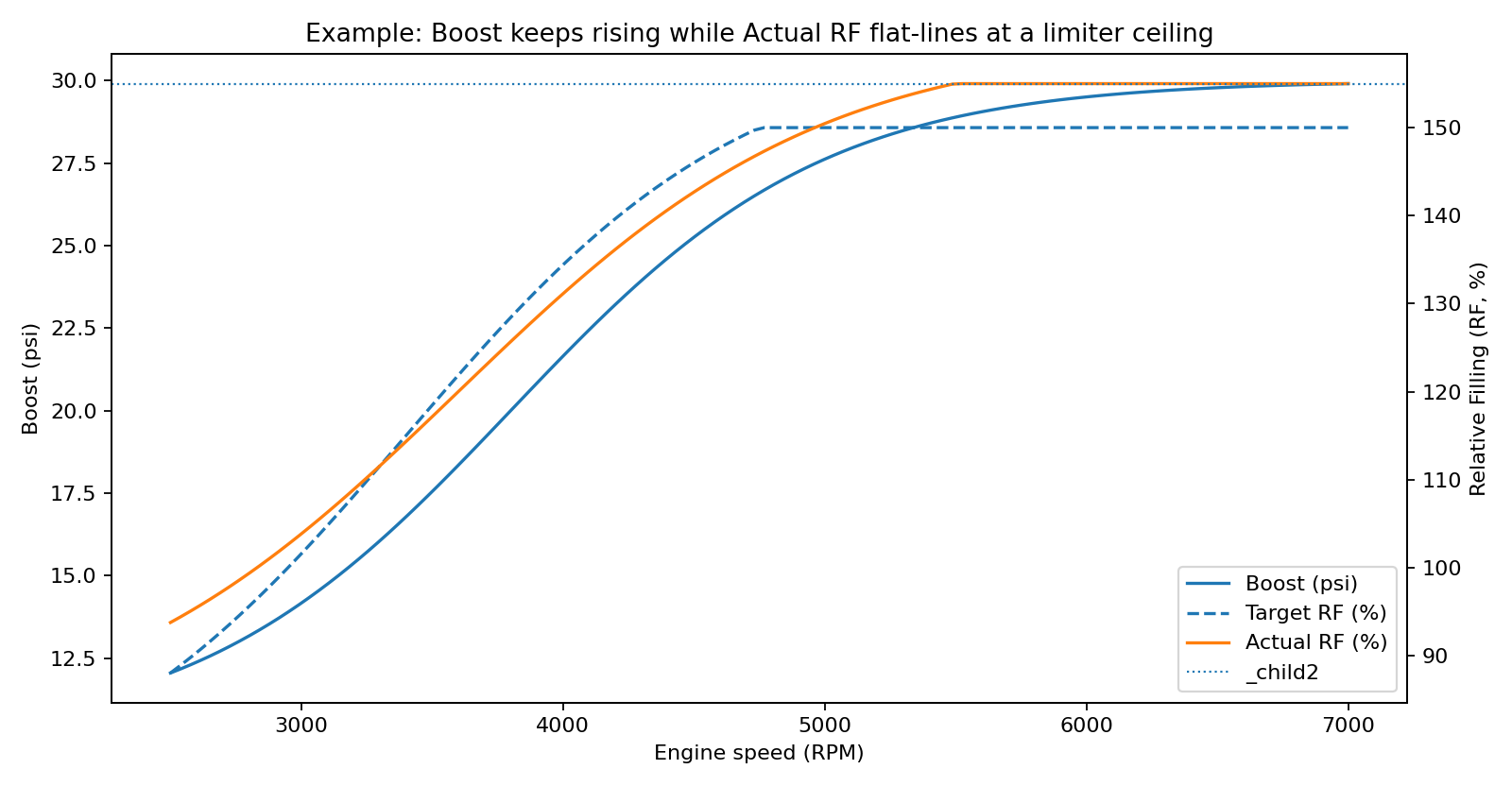
When Actual RF exceeds the allowed caps (or deviates too far from Target RF), MG1 assumes an over-boost or plausibility issue and intervenes.
3) How RF limiters and RF2 malfunctions happen
While details vary by software version, MG1 typically uses:
- Maximum Relative Filling limiters (hard caps; often RPM/temperature/gear dependent)
- Target vs Actual RF deviation checks (overshoot for long enough → fault)
- Load limitation (%) paths that can cap injection/load requests
- Pressure plausibility checks (MAP/charge pressure vs model expectation)
To the driver: the car pulls hard, then “hits a wall” at the top of the gear.
4) Why sensor “tricks” aren’t enough
Some attempt to dodge RF issues by rescaling/clamping MAP/MAF or torque signals. That can postpone faults, but it makes the model dishonest.
On MG1, torque-based functions (ZF8 behavior, traction, protections, diagnostics) depend on an accurate relationship between:
- airflow → RF → load → torque → boost/fuel/timing
If you “lie” to the ECU, you trade one ceiling for multiple side effects (bad shifts, inconsistent traction behavior, weaker protections, messy logs).
5) The Synergy approach: fix RF at the model level
To run a reliable 30 psi tune, we rebuild the entire load path so MG1 matches your hardware:
| Step | Action | Why it matters |
|---|---|---|
| 1 | Rescale Maximum RF limiters | Raises and reshapes filling caps to reflect real mass airflow while keeping safety margin |
| 2 | Align torque vs RF models | Keeps torque prediction monotonic/linear to prevent oscillation and shift issues |
| 3 | Raise load limitation (%) where appropriate | Prevents hidden caps from cutting load/injection at high boost |
| 4 | Re-calibrate plausibility checks | Stops MG1 from interpreting strong airflow as a sensor failure |
| 5 | Retune boost/WGDC strategy | Keeps target and actual RF tracking clean without overshoot |
6) Data-driven RF diagnostics (what we look for in logs)
When a car hits an RF wall, logs usually show:
- Boost/airflow rising, but Actual RF flat-lines
- Target filling drops suddenly as a fill-limit reason is triggered
- Torque intervention and faults appear after the pull
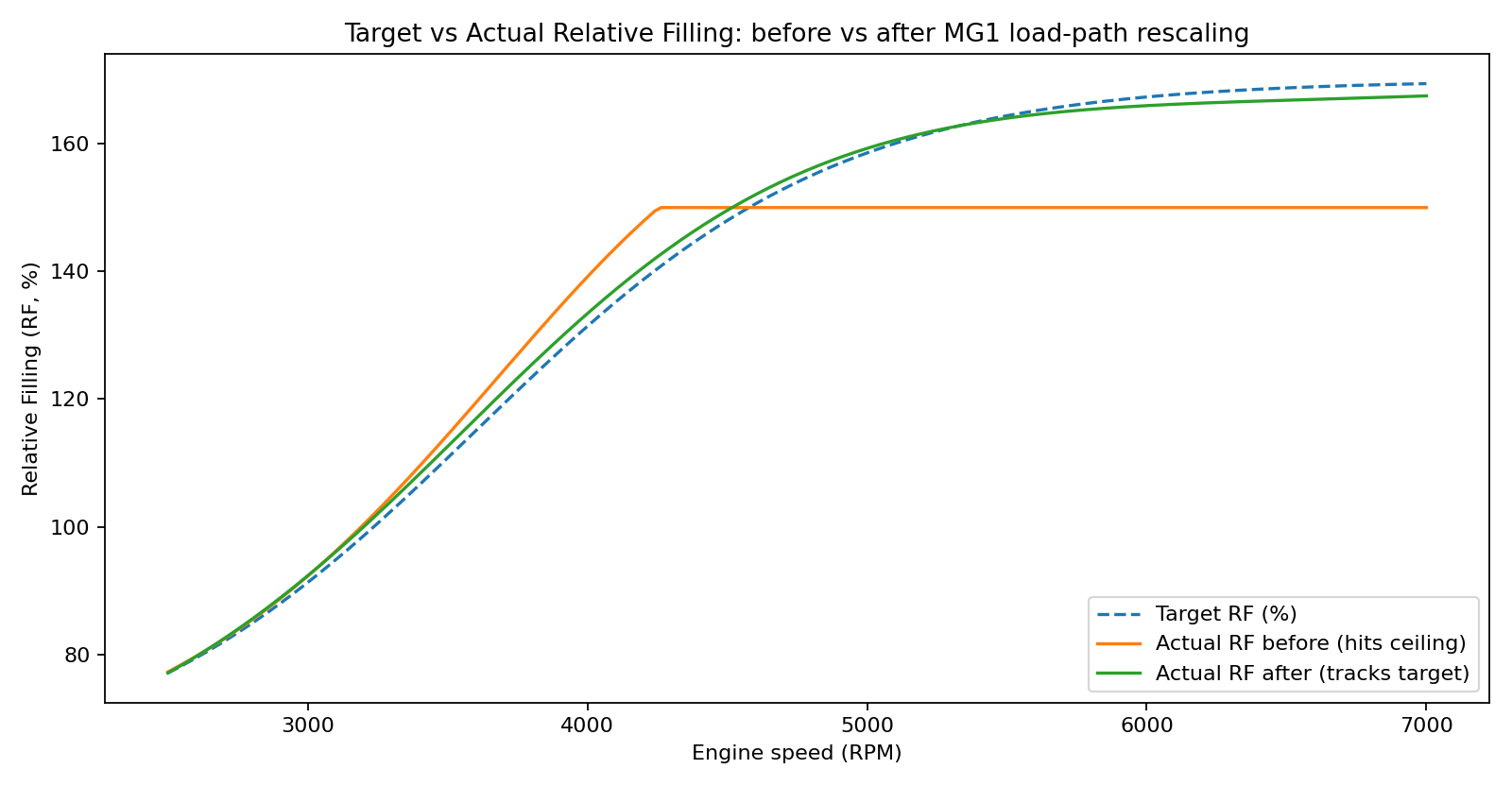
The fix is mapping/validation until Target and Actual Filling track through the full pull—without breaking OEM-grade protections.
7) Expert note: injectors and fuel scalars matter
Higher-flow injectors (including S58-based setups) require correct characterization. If fuel scalar data is off, MG1 can miscalculate load/torque and trigger plausibility checks—even if RF caps are raised. Injector modeling must be correct before finalizing RF/torque rescaling.
8) The outcome: smooth power, no ghost codes
A correctly calibrated big‑turbo Gen 2 B58 should:
- Hit target boost and RF without flat-lining
- Deliver smooth, consistent torque with factory-like ZF8 behavior
- Maintain honest sensor/model relationships so protections still work
Stop chasing RF codes. Once the Relative Filling model is rescaled correctly, a 30 psi E‑blend Gen 2 B58 with a big turbo can pull clean to redline—log after log—without mystery throttle closures.
Ready to fix your RF wall the right way?
FAQ
What does Relative Filling (RF) mean on a B58?
Relative Filling is the Bosch MG1 DME’s way of expressing how full each cylinder is versus a reference 100% load level. Values above 100% indicate boosted operation, and MG1 uses RF to calculate torque, fuel, and boost targets.
What causes RF2 and Relative Filling malfunction codes on a B58?
RF2 and related RF malfunction codes usually occur when Actual Relative Filling exceeds the Maximum Relative Filling limiters or deviates too far from Target Filling. This is common on big‑turbo Gen 2 B58 builds running ~30 psi where airflow exceeds the factory model envelope.
Why do big‑turbo B58 builds hit an RF wall around 25–30 psi?
The stock MG1 model and RF limiters were not designed for the airflow a 67 mm (or similar) turbo can produce. When airflow at high boost exceeds OEM filling caps, MG1 assumes an over‑boost or plausibility error and intervenes with torque reduction (throttle closure/load cut).
Can I just trick the MAP or MAF sensors to avoid RF codes?
Sensor “tricks” can delay RF faults but they break the torque model. That compromises protections (knock/component), shift quality, traction logic, and diagnostic accuracy. The correct fix is to rescale RF limiters and align torque/load models to the real airflow.
Do S58 injectors affect RF and load calculations on the B58?
Yes. If injector characterization or fuel scalars are wrong, MG1 can miscalculate load/torque, which can trigger plausibility checks even if airflow modeling is close. Injector data must be correct before finalizing RF/torque rescaling.
How does Synergy BMW Tuning fix B58 RF problems?
We raise and reshape Maximum RF tables, align torque vs RF models, adjust load limitation (%) and plausibility checks to accept higher airflow as normal, then retune boost/WGDC, fueling, and timing so 30 psi E50 big‑turbo setups pull cleanly without RF2 faults.
Need help with RF2 / Relative Filling faults?
Explore B58 tuning (Gen 1 and Gen 2): /tunes/b58<br /> Book B58 custom remote tuning: /b58-custom-mhd-tuning<br /> Send logs for review: /services#data-log-review
FAQ
Pick your platform, select your hardware stage, add what you need, and checkout to start intake immediately.
Get a Quote →